The Pain Killer

In which we meet a hero

The Pain Killer was born for the second time when his family died. 

Or more accurately, after he had watched his wife, children, parents and siblings rot to pieces in front of him. Their screams had been just another sound in the hell that had become their village. One after another, no matter the water poured between cracked lips, the bandages placed over festering flesh. There was nothing he could do. 

And when his oldest child finally passed, and he looked down upon himself and saw the rot beginning to spread across his tanned torso, he began to laugh. He wrapped his shaking form around the stinking remains of his loved ones and he gave himself away to the void. 

The void had sent him back. 

He now wore a thick grey fur cloak, a long way from the thin woven clothes his wife had made for him when he had lived before. A continent away, centuries past, but the loss burned fresh within his body.

He had spent weeks journeying to this town. As he approached, a familiar wailing rose from inside the walls. The snow on the road was splattered with red.

He could see the pain even from this distance, a dark miasma in a frenzy above the buildings. Meaningless slaughter had released the pain that had been held in those bodies, leaving it to dart and swirl until it found a target amongst the living. 

Though pain could be generated by humanity, it could not easily be removed from the world. It might transform into grief, or physical pain, or mental anguish, it might linger for weeks or decades, moving from host to host. But it would not naturally dissipate.

The Pain Killer was one of the only ones left with the knowledge of how to ground pain. He had met others at major catastrophes, their interactions limited to professional nods of acknowledgement. But there seemed to be more and more pain erupting across the world, and fewer and fewer of them left to face it. 

A light-haired young man had his hands pressed to the rough stone of the town wall. His head was bent, back heaving with deep retches interposed with sobs. Pain roiled around him, an impossible amount attempting to burrow its way in. 

The Pain Killer kept his distance. He inhaled, and began to draw the filaments away from the bent figure, bracing himself against the lashing anguish. He channelled the darkness into the ground below, trapping the writhing mass in depths warmed by the Earth’s core. As he worked, the figure of the young man unbent, still burdened by grief but no longer maddened by it. 

The Pain Killer eyed the young man. There were so many here that could be born into another life. Into this life. He could taste rage, grief, blood in the air. And there was more and more pain in the world, spreading from man to man like pestilence. 

And yet even for the sake of the world, he would not have another be born again as he had been. He would not cause another to ‘live’ as he lived. 

This young man would heal. 

He never could.

The Taste of Lies

In which we hear about pies and lies

The Taste of Lies Part I

She tasted lies young. Much younger than most other children of the town, who were strategically warned by mothers and nursemaids that if you lied, a four-headed serpent with teeth as long as your arm would bite your tongue clear off. And you would also be sent to bed without supper. 

Guppy had no mother, no nursemaid, went to bed without supper more often than not, and never encountered a four headed serpent.

What she did encounter was taste

The first time had been after she swiped a particularly fine looking meat pie left cooling in the baker’s window. Belly full of evidence, she had widened her eyes in panic at the baker’s wife and hurriedly denied any knowledge whatsoever of meat pies in general, let alone this specific pie (it had been remarkably buttery and crumbly, with a firm meaty middle, riddled with chunks of apple). 

At her bumbled denial, Guppy’s mouth had flooded with eye-drenching sourness, a taste that seemed to be dissolving her teeth as well as her tongue. 

She’d managed a wavery smile convincing enough to send the baker’s wife off after another target, before sticking her mouth under a spigot and scrabbling at her tongue with dirty fingers. The taste of pie was long gone.

In a land where lying was accompanied by such unpleasant consequences, most everyday folk stuck to the truth, or at least as near the truth as would mitigate the risk of tongue scorch and public shaming. Guppy, however, began to try lie after lie, exploring the flavours and learning to tolerate the taste until she could keep all trace of the terrible mouth experiences from her face.

She discovered that white lies tasted bitter-sweet, less dreadful than bold-faced lies, but still with a lingering edge of after taste. Lies of exaggeration bubbled with rotten fumes akin to the smells from a dung heap. Lies of fabrication, including tales told to entertain, would result in an explosion of salt, as though your tongue were caked in crystals. 

She got away with it all too, until she encountered the boy.

He had been visiting the market for a week now. He looked about six or seven, with a painfully thin face that often had tear tracks streaking through the dirt. Guppy had watched him clumsily swipe food from several of the stalls, and was pleased to see that the stallholders who noticed his thefts kept quiet, eyes sympathetically watching his frail frame. 

Then the boy stole from the wrong stall. The baker’s wife set to screeching as soon as she saw her missing loaf, drawing the swift attention of a town guard, who hared after the boy and had him pulled up by the collar in a few strides. 

The boy had had the sense to ditch the bread as soon as the woman had started her howls, but the baker’s wife pointed one plump finger directly at Guppy, who had unfortunately been front and centre for the entire debacle. There was no time to dart elsewhere. 

The guard turned to her, the boy gasping in his grip.

‘Girl. Did you see this boy take bread from the woman’s stall?’

Guppy gulped. She could lie, but it was fairly clear that the boy was the culprit and she didn’t want it revealed that she could speak untruths. But if she told the truth, the boy was probably headed for a life of slavery. The boy’s eyes were huge in his haggard face, beseeching her with silent pleas.

‘I saw him.’ 

Guppy looked down, unable to meet his gaze. And as the guard whirled away with the boy in hand, she felt a curious burning begin in her mouth. Within moments, her tongue seemed to catch alight, scorching the roof of her mouth into blisters, and forcing a whimper to escape her well-trained lips. 

Later, as she lay with a rag dipped in cool water inside her mouth, she thought that this must be the taste of betrayal. The result of speaking what you know is wrong in your heart, no matter the technical truth. 

The boy’s eyes continued to haunt her. 

Swollen-tongue be damned. He wasn’t going to disappear on her watch.


The Taste of Lies Part II

Iceberg

In which I had to go out

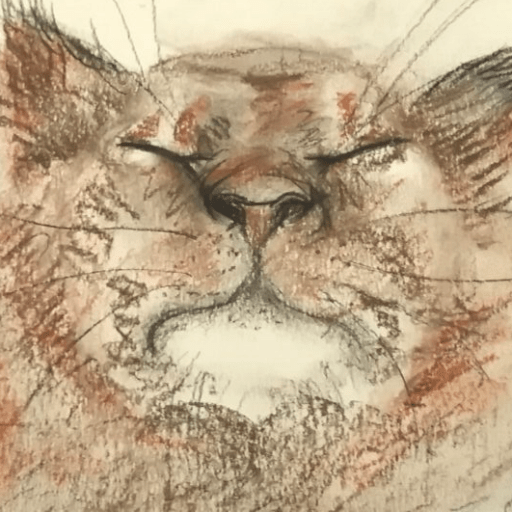
Chalk sketch of a lion by Isla Kennedy - Medically Unexplained

I went to choir on Thursday.*


* Actual process:

1. Wake up and scan through body. 

Is there cramping? [Y/N]

Will this cramping escalate and prevent you from going? [Y/N]

If “Y”, message choir director. Experience extreme guilt. Skip to step 9.

If “N”, eat, then take painkillers. 

2. Are you still cramping or has cramping started since this morning? [Y/N]

Will you have to take (more) painkillers? [Y/N]

If “Y”, half an hour before taking them, eat to line stomach in order to avoid gastritis.

3. Are you still cramping? [Y/N]

If “Y”, eat, take painkillers around an hour before getting on the bus.

4. Make sure you bring a vomit bag, tissues, water, more painkillers. 

5. Select the bus seat least likely to induce cramp of the ones available. Do not get on the bus if there is no seat. 

Sit bolt upright and as still as you can. 

Simultaneously attempt to spread out and wedge yourself securely.

Manspread without upsetting the person next to you.

Try to relax.

6. While in choir, hydrate, relax, and roll shoulders.

Sing.

7. Are you still cramping? [Y/N]

If “Y”, during the mid-practice break take more painkillers. 

8. Is the cramp getting worse? [Y/N]

If “Y”, get off the bus early and walk the rest of the way home. 

9. Is the cramp still bad? [Y/N]

If “Y”, move pillows and duvet to the floor.

Eat to line stomach.

Take painkillers.

Apply ibuprofen gel.

Apply ice packs.

Move plastic bin within arm’s reach.

10. Leave food and water on the floor nearby in case you need to take more painkillers in four hours’ time. 

11. Attempt to sleep on the floor. 

12. If cramping escalates, wake in four hours, eat, take painkillers. 

13. Apply hope protocol.

Self-storage

In which we step behind the doors

Photo of a modelling clay animal sleeping by Isla Kennedy - Medically Unexplained

*Just in case this comes across as a bit concerning, I’m okay! I wanted to explore the concepts below as speculative fiction, please note that there are potential triggers around suicide.

People come here to die. 

When you’re unwanted, or too old, too helpless, too ill. When you feel like you’re a millstone around your family’s neck, when your mind begins to go and you don’t want your children to see your emptying shell, when you can’t bear to watch your parents try to smile as your body wastes, when you’ve bankrupted your family and can’t look in your wife’s eyes, when you’re too lonely and can’t stand the quiet for one more day. When you cannot try any longer.

This is where you come. 

You press your hand to a digitised waiver. You walk down row upon row of brightly painted doors until you come to your assigned number.

The door opens at the touch of your palm to the plate, the lights flick on automatically. There’s a long chair in the middle, one that reclines all the way back with adjustable everything. There are monitor patches to stick on all over, so you have to strip off and slip one of their gowns over your head. There’s a box for your clothing and anything else you brought with you. 

Most people have nothing else to put in it.

Next to the chair is a dark grey VR helmet, padded and ventilated through gills at the side. Cords run from the helmet to the wall, snaking away into the unknown. You sit and lean backward until you’re nearly horizontal. The helmet slips over your face and –

There are hundreds of these places all over the country. Whoever designs them always seems to choose primary colours for the doors. Maybe they think that’s more cheerful than beige.

Once a client has settled into their room and become fully immersed in their chosen virtual reality simulation, a team of begloved carers inserts catheters and feeding tubes and hooks up the monitors. That’s the way things stay until the client checks out. Terminally. 

It’s meant to be a good way to go. You get to live in a virtual world that’s designed to avoid stressors and sources of misery, and they make it as gentle and pain-free as possible. 

There have always been stories, of course. The one about the self-storage unit that got raided and they found nothing but empty beds and a whole lot of organ transport boxes.

Or the one where they didn’t bother with any of the body maintenance so emaciated people were dying in a lake of their own piss and faeces.

Or the one where they set up a side business and let people in to do whatever they wanted with the bodies while the minds were hooked up to the VR. 

I guess there’s always some sicko looking to make an extra buck. 

The thing is, even the units that operate under the law have a major snag. That waiver you sign says you’re not allowed to change your mind: you’re never allowed to check out or be checked out.

I wonder how many people this no takesie-backsies rule has left trapped inside.

The state likes self-storage though. Way cheaper to run than care homes or state facilities, easier to deliver medical assistance, and the state gets to claim any assets to pay for care. They’re trialling it ‘voluntarily’ in prisons, so offenders get to feel like they’re free, and prison staff no longer have to deal with violence or drug abuse. 

There are more and more self-storage facilities springing up. Squat towers with corridors that wind around and around, each lined with an orderly array of doors.

Behind those primary coloured doors, a hundred minds spin away.

And so it goes

In which I venture forth

I emerge from my chrysalis. It’s daylight and the sheets have transformed into a hitherto undiscovered substance during my time inside them.

The chrysalis stage involves me, the floor, and the bathroom. I usually stop bothering to eat solids after a while so I can promote myself to vomiting in the sink instead of the toilet (pro-tip). Plus it’s hard to appreciate the colour of bile in a loo.

The final chitterings of cramp have quieted down, prompting the cracking of the sheet walls. A twitched curtain gives a blinding indication that the weather (rather selfishly) has stopped providing an excuse for extended pupation.

My butterfly transformation equates to having a shower, my hair no longer being scraped into a grease-sheened lopsided lump, and my skin making First Contact with Not Pyjamas.

It turns out my nine-ish days of sleep-vom-don’t-bother-rinsing-repeat has led me to forget how temperature relates to my wardrobe (I’ve been meaning to make a Dummies Guide to the coats I own and the temperature bands they function in). Still, I understand that a healthy glow is desirable?

In the words of Pratchett, I am glowing like a pig.

I find myself faintly surprised that the outside world actually looks familiar. It feels like the rest of the world should surely have undergone some sort of metamorphosis as well, but there’s the same old pavement with the same old malformed Lucozade bottle and faded ruin of a Quavers packet.

Home, sweet home.

Life outside my chrysalis scrapes the ears and eyes, but also contains delights such as non-frozen or tinned foodstuffs, and other people – some of whom I actually like. (I might not be deemed the most social of butterflies).

There are queues to stand in, the Tube to be delayed on, inconvenient misunderstandings to have with pharmacies, piles of ignored messages to respond to, and those oh-so-delightfully crunchy sheets to wash.

Today is a good day. It might not be long before my butterfly self catches alight but, on the plus side, a caterpillar always crawls from the ashes.

Ode to Ibuprofen

In which I dwell on a love lost

Pencil and watercolour sketch of a snake eating frogspawn by Isla Kennedy - Medically Unexplained

I was young when I met you.

I, sixteen, and you sixteen in a pack – so strong, so reliable. You seemed so available back then.

I couldn’t get enough of you. Ignored the murmurs from my family, my friends.

I needed you.

But your sugar coating was skin deep.

You turned my bowels into burning pipes of doom.

O! The diarrhoea!

The tender eruptions of our love!

My stomach filled with the broken shards of our promises, and inflated till it tried to escape my chest. Vomit stained my nights.

My stomach in my mouth, I had to let you go.

Many years have grown between us now. I watch others flirt with you and bite back warnings. They will learn.

He sleeps now, my Morpheus, he doesn’t know I once loved another. He is a gentle tonic after your burning love, for all that he is slow to respond when I call him.

You, oh, you were my first love.

I wonder sometimes, if I were to meet you again, would we be as once we were?

Sweet sixteen and the pain of the world washed away.

But my digestive system belies my heart.

My guts have never forgiven you.

The MUPS-Files

In which we discuss MUPS (which isn’t a puppy with a suspiciously lumpy neck)

There’s a basement under the Great Hall of Diagnosis. It’s never talked about and the basement door can only be reached by traversing the myriad doors and corridors of the upper floors, with their neat, rectangular, printed labels (Erythromelalgia – Gonorrhea – Vitiligo – Yellow Fever – Ichthyosis).

The label on the basement door is handwritten with an attempt to look authoritative – right up until the writer realised they were running out of space and the letters began to get smaller and smaller:

‘Medically Unexplained Physical Symptoms (MUPS)’

Underneath, on a scrappier piece of paper, someone else has scrawled in blobby biro,

‘Welcome to the X-Files’

The basement’s occupants are numerous and varied. Every time medical testing fails to allocate a condition to one of the more reputable rooms above, it gets dumped in the basement.

The patient, meanwhile, receives the good/bad news that there isn’t a diagnosis. On the one hand, you’re not dying more quickly than you ought to be, as far as medical science can tell. On the other hand, we can’t find a reason for those physical symptoms, so we can’t treat them.

The unfortunate subtext is that there isn’t a real reason for the symptoms. There’s a sneaking suggestion that the cause of the symptoms is something psychological rather than physical, of the mind rather than the body.

The mind is a product of the body, of course, and undoubtedly can induce and influence the body’s behaviour. And yet it seems curious that this is the only explanation given weight. There is rarely any mention of the possibility that medical science might develop and learn more, and eventually figure out that there is a determinable cause for some of these conditions.

Conditions like Fibromyalgia and Chronic Fatigue are finally making the journey from the MUPS basement to newly decorated rooms with printed labels on the floors above. Evidence has been found and explanations have been developed following extensive research. Medicine is acknowledging that there is something real to find out about, and is finally validating the experience of all those people who were told it was in their minds.

On two occasions, I’ve been the patient listening to a consultant say they can’t find anything wrong. On both occasions, I nod, and silence falls. I wait for a suggestion of a next step, a new test or another referral, but their benign smiles remain impossibly fixed. I begin to feel flutters of frantic panic, a desperation for something, anything to hold on to, a gasp of hope. They give me nothing.

I wonder if they’re waiting for me to say the words for them, ‘There’s nothing we can do,’ and see myself out. I eventually received a ‘Good luck’ from one of them, but it tasted bitter in its emptiness.

Being designated to the MUPS basement leaves you unlabelled, open to the slow erosion of society’s slurs for those who lack a medically approved stamp: lazy, attention seeking, hysterical, weak, a drain on resources.

I’d like to get out of the basement one day.

Hello Hyde

In which we meet a mysterious stranger

I have things a good deal easier than a lot of people. I don’t have continual, endless pain, I don’t have a permanent physical disability, and my brain more or less manages its chemical levels without too much intervention.

Some of the time, I’m okay. I can function, push through a bit of fatigue and get on with things.

But then I get a timely reminder: Mister Hyde is never far from the surface.

He emerges when I’m sitting in a meeting and twisted to the side, or I’ve been for a walk, or I’ve been sitting in a car or bus, or I’ve done something physical, or become stressed or excited or upset, or on a few occasions, he’s emerged when I’ve been sleeping – which is possibly his idea of humour.

Hyde arrives with an insidious cramping that creeps up and down my right side – from the muscles in my right butt cheek, all the way up my back, through my shoulder and pec, up my neck, and across the right side of my face.

He lingers and worms and burrows, pulling on nerves until the nausea builds and the pain ramps up. He’ll occasionally abate for a bit after I vomit, always the gentleman, but slithers back after a considerate pause. Ever the tease, he sometimes crawls along my muscles to chew at my calf, a potential precursor to him buggering off.

He usually rips his way back up.

Mister Hyde tends to stick around for two or three or four days, with little rhyme or reason to his presence. He’ll shut up a bit if I manage to chug painkillers in time and keep them down, but I can feel him lingering underneath, waiting for my bloodstream to empty. I lie on the floor (hard surfaces are easier to dig your muscles against), curtains drawn, waiting for him to leave me alone.

Mister Hyde is an absolute bastard.

He arrived when I was about thirteen, a curiously literal pain in the butt that would cause me to dig my rear against seat belt holders and the corners of cupboards. He grew as I did, spreading until now he sometimes flirts with the left side of my body, cramping a shoulder muscle or digging into my neck. A reminder that there is a whole lot of unconquered territory left, and that things could be a whole lot worse.