Close to the bone

In which I listen in the dark

I can hear the skeletons in my closet.

There’s a constant skittering, hollow clatters, the gentle knock of a skull against the door.

They’re pretty well behaved really. There was this one guy in the building next door who had a mammoth skeleton that he couldn’t close the door on, so it used to just follow around behind him. Man, you’d know he was walking down the street by this constant knocking sound, loud enough to shake your knees. He went crazy, that guy. Always screaming for the hulking thing to leave him alone. That’s what happens when you don’t deal with your skeletons. 

I took time to get to know mine after I saw what happened to him. That one, the one that’s scraping on the closet hinges, it hatched that time I turned someone down while in queen bitch mode. That one, with those elongated digits, it showed up when I didn’t send a message to someone I once loved. 

Skeletons hate being shut away, they want to lick up every drip of negative emotion you leak. That’s how they grow, tastes of guilt and shame and fear and regret. Sometimes mine escape the closet and run cool and smooth over my skin, chittering with delight when guilt blooms over me. They’re a bloody nightmare to get back in until they’re fed. Once they’re high on emotion, they slump into snoring piles on the mattress. I can scoop up a softened handful of bones and dump them back in and close the door. 

Sometimes I pull open the closet door to take them out. It’s kinda perverse, I know, but there’s something about staring right at the scabs of your past mistakes and wanting to peel them off till they bleed. Probably not so smart anymore, some of those old bones are getting hefty. 

Some folks say they don’t have anything in their closets, that you can beam pure positivity and starve those skeletons till they shrink up and die. Seems pretty unlikely to me, seeing as they’re dead to start with. 

But I do know that one of mine once disappeared. 

It had been made up of all these articulated segments of regret, they’d click one after the other against the door when it slithered free in the night. I’d first heard it after I’d lost someone I love in a messy puddle of pride, confusion and misery. It was years before luck struck and healed the heart wound that had brought that skeleton into being. And then the next night there was no click of coils in the closet.

I don’t know if I could heal those other wounds. Don’t know if I’d want to try either. That might just land me with something bigger clawing its way out.

And there’s something to be said for my skeletons. 

They’ve got spine.

Headsplosion

In which I have a snarflaghbafnastagblurt moment

I have a box in my mind labelled ‘Mouth Fail Recordings’. The lid is lovingly worn from the number of times I’ve rummaged through and replayed, ad nauseum. 

I am not good at being put on the spot. My tongue tends to flap and flop like a beached whale, spewing the absolute crap that my brain frantically throws at it from its blowhole. A delighted part of my subconscious grabs popcorn and records it all in high definition, preparing for inevitable slow-mo reruns. 

My brain reacts to most unannounced phone calls with a violent urge to flee for the hills and throw the buzzing grenade as far away as possible. I don’t have any extra information to stop my brain from short-circuiting: no warning, briefings or body language. So mostly I ignore the call, gird loins, and call back… Which I also loathe, because phone calls involve interrupting someone, shouting (or vibrating) into their lives unannounced. It just feels rude.

I would possibly have been better off in an era that relied on handwritten missives.  And networking by carrier pigeon.

I’m also a bit pants with on the spot face-to-face interactions. It took me a long time to be able to interact with cashiers or bus drivers without an ‘I carried a watermelon‘ moment. And then they introduced contactless payments and self-checkouts, so I assume the future is on my side. (Though they’ve also introduced recorded video interviews, which seems to be even more whale-tongue inducing for me). 

Technology has yet to throw pouncers with clipboards onto the scrapheap of a bygone era. I get that charitable causes need people to donate and need to find a way to make themselves visible, and I also get that most people aren’t me and probably don’t have a problem with the whole thing. But clipboard holders feel like lions in the long grass. I get stalked because I look approachable, and then I get savaged with guilt because I’m too polite to cut short the spiel. 

I assume the only people donating to charities are the really nice ones who can’t get away. Ditto with cold-calling. Which doesn’t seem all that charitable.

I don’t know if this kind of anxiety is heritable or a learned behaviour, but I’m not the only one in my family who views innocuous interactions with abject fear. And I definitely did have a toy telephone as a kid, it didn’t help.

Aside from exposure therapy, my only recourse is to await the development of mental grenades that can obliterate that box of mouth fail recordings, as well as those other boxes labelled ‘Social Awkwardness’ and ‘Shameful Misdeeds’.

It’s been a long time coming.

Unfranked

In which I contemplate interviews

Don’t disclose they advised. I have no tidy disclosure to make, no Latinate phrase to impress or Wikipedia page to authenticate.

I am unfranked.

I have a messy mouthful of words that stutter their way into the world. A tendency to tail away.

No it isn’t great, yes it does affect my working patterns.

Don’t read their expressions, don’t downplay.

I’ve got two-pilled dexterity of mouth, should have taken one, but the fear of pain was worse than a clumsy tongue.

I’ve got weevilling cramps riddling my face, eating into my brow

What did she just say?

How can we make this role work?

Focus on outputs not hours in the office, let me pick my brain when it’s ripe not rotten, trust me, respect me, realise that this is worse for me than for you.

I get home. Safe. Floor. 

I find it hard to trust me anymore.

Why should they?

A pigeon named Anxiety

In which we meet a constant companion

Anxiety was small and wrinkly when he nestled into my chest cavity. 

Two giant eyes goggled outward at the world beyond my body, decided it wasn’t for him, and he settled back inside.  

Now full-grown with a handsome sheen, Anxiety makes himself felt. 

He doesn’t like breathing into armpits on trains, or overhearing people who roll anger around their mouths. He doesn’t like navigating new places, or new people.

Sometimes he doesn’t like leaving the flat. 

Two unsteady feet hold my stomach in a death grip, with a squeeze-claw-squeeze when he shifts. 

He flutters gusty wings in agitation, fluffing against lung and making it harder to draw breath. 

And then there’s the head bobbing. An endless tapping that fills my gullet and knocks again and again on my chest wall.

He’ll calm when he’s talked to, sung to, or breathed at. 

And he’s as greedy as his out-of-body brethren, deflating when fed.

I can’t evict him, so I paste on a smile,

And wish I had a pigeon named ‘Poise’ instead. 

Time waits

In which I receive a call.

Come home, she says, a repeated plea.

Home.

There’s so much love there. Two people who will literally sandwich me when I’m howling and bathed in eau du vomit. They will hold me fast against the strange forces that wreck my body. They will feed me, comfort me, walk for me, and help me scrape the bottom of the barrel for sticky dregs of laughter.

Home.

Time stops there. Away from the life I have built for myself, the people I have collected, the places I call my own. There live the ones who knew me first, from knee high upward. There are the ones who taught me, inspired me, keep me in their hearts even now. It is there that childhood memories are unpacked.

Home brings summer flowers and cool rooms, new grown frogs and an old purring lap blanket. 

And yet a part of me asks, what then? 

Is this forever? 

Am I letting go of this life I’ve been building and falling a decade backward? Acceding to whatever it is that tears at my body?

Perhaps home must be given new lines to speak. I must dust it off, wipe away the sepia and see it in the light of the present. 

Safe harbour in the midst of this ship-wrecking storm.

Iceberg

In which I had to go out

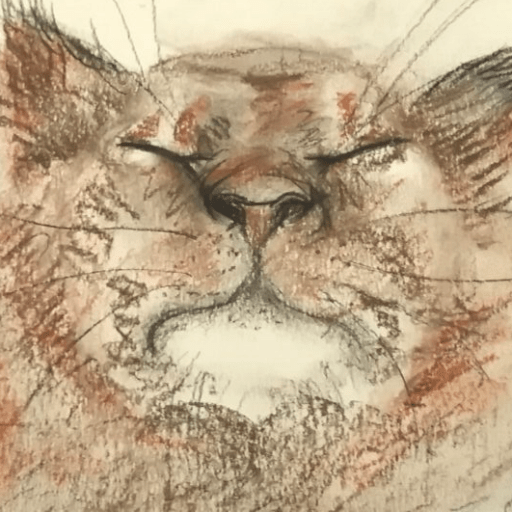
Chalk sketch of a lion by Isla Kennedy - Medically Unexplained

I went to choir on Thursday.*


* Actual process:

1. Wake up and scan through body. 

Is there cramping? [Y/N]

Will this cramping escalate and prevent you from going? [Y/N]

If “Y”, message choir director. Experience extreme guilt. Skip to step 9.

If “N”, eat, then take painkillers. 

2. Are you still cramping or has cramping started since this morning? [Y/N]

Will you have to take (more) painkillers? [Y/N]

If “Y”, half an hour before taking them, eat to line stomach in order to avoid gastritis.

3. Are you still cramping? [Y/N]

If “Y”, eat, take painkillers around an hour before getting on the bus.

4. Make sure you bring a vomit bag, tissues, water, more painkillers. 

5. Select the bus seat least likely to induce cramp of the ones available. Do not get on the bus if there is no seat. 

Sit bolt upright and as still as you can. 

Simultaneously attempt to spread out and wedge yourself securely.

Manspread without upsetting the person next to you.

Try to relax.

6. While in choir, hydrate, relax, and roll shoulders.

Sing.

7. Are you still cramping? [Y/N]

If “Y”, during the mid-practice break take more painkillers. 

8. Is the cramp getting worse? [Y/N]

If “Y”, get off the bus early and walk the rest of the way home. 

9. Is the cramp still bad? [Y/N]

If “Y”, move pillows and duvet to the floor.

Eat to line stomach.

Take painkillers.

Apply ibuprofen gel.

Apply ice packs.

Move plastic bin within arm’s reach.

10. Leave food and water on the floor nearby in case you need to take more painkillers in four hours’ time. 

11. Attempt to sleep on the floor. 

12. If cramping escalates, wake in four hours, eat, take painkillers. 

13. Apply hope protocol.

S.H.A.M.E

In which we journey to a future far, far (and hopefully further) away

Pencil sketch of a cat by Isla Kennedy, Medically Unexplained

They brought in S.H.A.M.E four years ago.

It stands for System for Health and Monitoring Efficiency, and it took the government years of bullying, bribes and blackmail to force companies into implementation. It was going to ‘transform productivity’, ‘improve stakeholder engagement’, and had to be ‘actioned immediately’.

Workers are pretty damn engaged. But mostly because they’re scared shitless.

It works like this: sickness and absence stats, start and finish times, and hours spent on productive tasks are all monitored by a national system that ties data to your National Insurance number and Health Service number. Everyone – from the CEO to the handyman – has to wear a digitised display badge with stats and rankings, and it emits an ear-piercing bleep every time your numbers slip. Teams get rewarded or punished based on collective performances. Productivity is the only thing that matters.

Once your stats drop too low, you can’t work for a company in the same tier any more – you have to move down to a lower tier company. Less pay, same badges. The sleep at the factory kind of deal with no-break shifts, no daylight, and no real money.

If your stats slip too far, there are no jobs. No one can take on a dud in case they have to fork out for rehabilitation training. S.H.A.M.E Central Services take the offender somewhere for a few weeks and drill into them that they need to be less shit. Then they get their badge numbers bumped up just enough so they can work in the lowest tier. “Rehabilitation” costs way more than most people can afford, and more than most companies want to pay.

No badge means no money and no health services.

The government says that measures are in place for S.H.A.M.E to work for everyone. It says that those with a confirmed diagnosis receive an allotment of extra points on their badge. It says that you can get a badge with larger font displays. Or with digi-braille. It says that anyone who’s fallen out the bottom has chosen to ‘not be part of a successful system’.

The government says a lot of things.

They’re launching S.H.A.M.E in America now, and half of Europe is a S.H.A.M.E zone. Apparently the UK’s been an astounding success case.

It’s like they can’t even see all those people sleeping on the streets.

Meat coat

In which I peruse my wardrobe

I walk into my wardrobe each morning and select my meat coat.

It barely takes me a minute. The bones and sinews of my hand reach toward the well worn coat in the middle of the array. Like the others on display, it shines pale in the cool light of the wardrobe – amphibiously pale, as someone once pointed out, though sadly lacking in mucus. It is somewhere in the middle of the other meat coats, heavier than those that are more wetsuit than meat coat, but less bulky than those at the far end.

The meat coat I choose bears more signs of wear than the others. Faint tan lines around the neck and shoulders, a spatter of freckles at the elbows, slightly better skin from all that moisturising. I should really moisturise the others more often, but the topography of even the thinnest coat is tricky without a body inside it. Every time I nick this meat coat, I faithfully replicate the slice on each of the others, and pay close attention to ensure the healing scars match. Wouldn’t want to cause a scandal.

My mother, of course, thinks I’ve made a foolish choice and should swap my current coat for a lighter one, one that doesn’t come with a range of risks for disease and ridicule. My mother and brother are both wearers of leaner coats, tan skin taut over veined muscle. I can see her bite back words of worry when she looks at me, when she spies the lack of gap between thighs, the lip of belly, the softness beneath chin. She doesn’t always manage to bite back successfully.

This meat coat comes with a lack of expectation. It doesn’t play the game that the thinner coats would have to play, and isn’t a target for the flak that the heavier coats would receive: it is happily on the sidelines. It comforts rather than threatens, and it remains invisible to most. It feels safe.

I’ve never worn the thinner coats. I wonder if I would feel like a child wobbling in high heeled shoes. A newborn colt, suddenly exposed to the world’s gaze. I’ve crawled into the meat coats at the far end, the ones that don’t like to move, their softness both comforting and claustrophobic.

Venturing out without a meat coat is the greatest taboo, of course. But I thirst for a morning where the meat coat I choose is of no consequence. It signifies nothing. Holds no import in comparison to the person it covers. That isn’t how we work, of course. We constantly seek a reflection of our insides on our outsides, uncaring of whether it actually is a reflection or not.

If the world were blinded, it wouldn’t be long before those with the sweetest voices were sanctified.

I hang my meat coat away. And breathe freely.

Isla’s web

In which we consider the nature of relationships

I stand on an island.

Isla on an island. (How satisfying.)

It’s around 30 feet across, covered in the springy grass that only grows atop really peaty soil. About two feet in from the edges are thick metal loops that have been hammered into the ground, each as thick as my wrist and veined with faint reddish streaks. They’re buried at one foot intervals around the circumference of the island, and while some lie empty, others hum and spark.

The one nearest me is barely visible beneath a mass of shining, seething threads, each stretching and intertwining with its sisters to form a single thronging rope that throws itself beyond the island and out into the mist. This is by far the busiest hive of threads.

It leads to my mother’s island.

Every thread is a message, a photo, a phonecall, a hug, a shared laugh, a rushed journey to comfort, a warm meal, an eye roll, a word to the wise. The threads dash from my end to hers and back, the rope between us now too thick to grasp in both hands and electric with activity.

A short walk away lies another loop. This one empty but for a single sparking thread that noses the air, then tentatively slips away into the mist.

Let us watch and wait.

After minutes-days-weeks, the thread begins to vibrate, and from beyond the island comes another line, intertwining with mine until it reaches the metal loop. As it does, the filaments grow brighter, stronger. This is the birth of a friendship, the tentative creation of a relationship that will grow stronger as the threads continue to weave between the islands.

On the other side of the island are the loops I avoid, letting my eyes slide away as I walk past and tend the others. They still have thick bundles of threads tied to them, but they are withered and grey. There is no spark, no movement, and if you stand and watch, you see only fraying and splintering. Some of those cords still stretch in vain out beyond the island’s edge, but others hang limply over the side, severed and flailing helplessly in the wind.

The threads of these relationships stopped flowing: one too many missed calls or failed replies, a long forgotten argument, a barrier of pride.

One too many cancellation.

Every time I cancel – a dinner, a birthday, a meeting, a concert, a rehearsal – I watch a nascent thread falter and fall still. For newborn relationships, it can be fatal; with established relationships, I can see a thickened scar of burnt out threads.

I tend to my island with love, haunted by the burnt out cords that flap failure in my wake.